
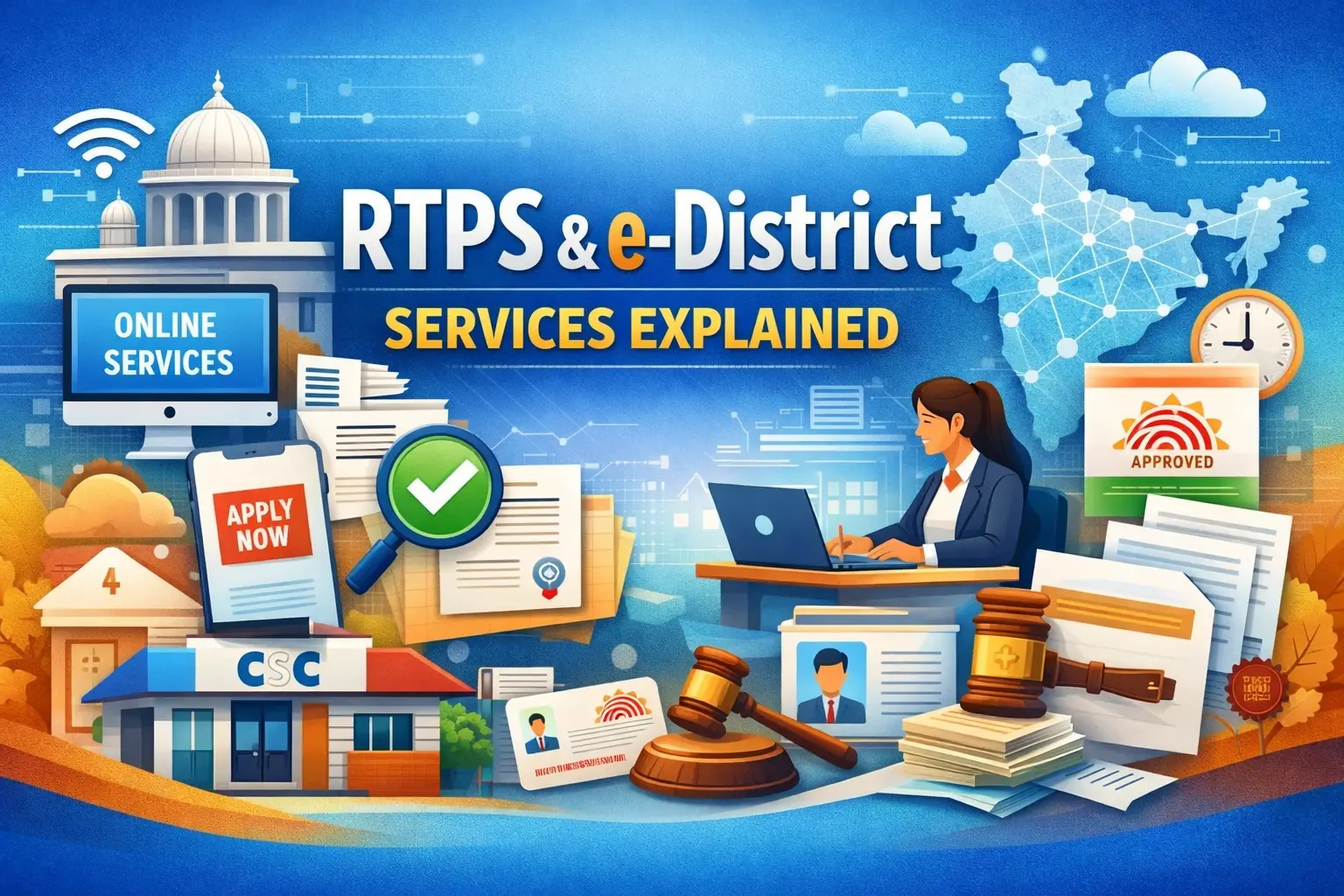
Introduction
In the digital governance era, governments across India are transforming public service delivery through technology-driven platforms. One of the most impactful initiatives in this direction is the RTPS and e-District Mission Mode Project. These systems are designed to provide citizens with fast, transparent, and accountable access to essential government services without unnecessary delays or middlemen.
The Right to Public Service (RTPS) framework ensures time-bound delivery of notified public services, while the e-District Mission Mode Project (MMP) digitizes district-level services under the broader Digital India initiative. Together, they aim to reduce administrative inefficiencies, enhance transparency, and improve citizen satisfaction.
What is RTPS?
RTPS stands for Right to Public Service. It is a legislative or policy-based mechanism introduced by various state governments in India to guarantee the delivery of specific public services within a stipulated time frame. If the service is not delivered within the prescribed period, responsible officials may be held accountable and penalized.
Objectives of RTPS:
- Ensure time-bound delivery of public services
- Increase administrative accountability
- Reduce corruption and delays
- Improve transparency in governance
- Empower citizens through legal entitlement
Under RTPS, citizens can apply for services such as caste certificates, income certificates, domicile certificates, birth and death certificates, and other essential documents. The system typically provides an application number through which applicants can track the status of their request online.
What is the e-District Mission Mode Project?
The e-District Mission Mode Project is part of the National e-Governance Plan (NeGP) and now aligned with Digital India. It focuses on digitizing district-level administrative services and delivering them electronically to citizens.
The project integrates various government departments at the district level and provides services through:
- Online portals
- Common Service Centers (CSCs)
- District e-Governance Centers
- Mobile-based platforms
The core goal of e-District is to simplify government procedures and provide seamless electronic access to high-volume citizen-centric services.
Key Features of RTPS and e-District Services
1. Online Application System
Citizens can apply for services from anywhere using an internet connection. This eliminates the need to physically visit government offices multiple times.
2. Time-Bound Service Delivery
Each service has a predefined time limit. Authorities must process applications within this period.
3. Application Tracking
Applicants receive a unique reference number to track real-time status updates.
4. Digital Certificates
Certificates are issued digitally with verification codes or QR codes, reducing forgery risks.
5. Transparency and Accountability
Officials are accountable for delays. Some states impose penalties for failure to deliver services on time.
6. Integration with CSCs
For citizens without internet access, Common Service Centers provide assisted digital services.
Major Services Offered
Although the exact services vary by state, the commonly available services include:
- Caste Certificate
- Income Certificate
- Residence/Domicile Certificate
- Birth Certificate
- Death Certificate
- Marriage Registration
- Land Records Access
- Pension Applications
- Ration Card Services
- Social Welfare Scheme Applications
These services are crucial for students, job applicants, entrepreneurs, and beneficiaries of government schemes.
Benefits to Citizens
1. Reduced Corruption
Digitization minimizes human intervention, reducing opportunities for bribery and manipulation.
2. Time and Cost Savings
Citizens no longer need to travel repeatedly to government offices.
3. Easy Access
Services are available 24/7 through online portals.
4. Legal Assurance
RTPS provides a legal guarantee for service delivery within a defined timeframe.
5. Improved Record Management
Digital records improve efficiency and prevent loss or damage of documents.
Benefits to Government Administration
The implementation of RTPS and e-District has also strengthened administrative systems.
- Better monitoring of service delivery
- Performance evaluation of officials
- Centralized database management
- Reduction in paperwork
- Data-driven policy decisions
Government departments can generate reports and analytics to identify bottlenecks and improve workflow efficiency.
Role in Digital India Initiative
RTPS and e-District services support the broader goals of the Digital India programme by promoting:
- Digital infrastructure as a utility
- Governance and services on demand
- Digital empowerment of citizens
By integrating services into a unified online system, the government moves closer to a paperless and faceless administration model.
Challenges in Implementation
Despite its advantages, the system faces certain challenges:
1. Digital Divide
Rural populations may lack internet access or digital literacy.
2. Technical Issues
Server downtime or portal errors can delay applications.
3. Awareness Gap
Many citizens remain unaware of their rights under RTPS.
4. Interdepartmental Coordination
Efficient integration between departments is necessary for smooth operation.
Continuous training, infrastructure upgrades, and public awareness campaigns are essential to overcome these challenges.
Future Scope of RTPS and e-District
The future of digital governance lies in further automation and integration. Possible developments include:
- AI-based application verification
- Blockchain-based document authentication
- Mobile-first service platforms
- Integration with Aadhaar and digital identity systems
- Real-time grievance redressal mechanisms
As technology evolves, the efficiency and reliability of RTPS and e-District platforms are expected to improve significantly.
How to Apply for Services (General Process)
While procedures differ slightly by state, the general process includes:
- Visit the official RTPS/e-District portal of your state.
- Register using mobile number or email ID.
- Select the required service.
- Upload necessary documents.
- Submit the application and receive acknowledgment number.
- Track application status online.
- Download the digitally signed certificate upon approval.
For offline assistance, applicants can visit their nearest Common Service Center.
RTPS and the e-District Mission Mode Project represent a transformative shift in public service delivery in India. By ensuring time-bound service delivery, increasing transparency, and leveraging digital platforms, these initiatives strengthen citizen trust in governance.
They not only simplify administrative processes but also empower citizens with legal rights and digital access. As digital infrastructure expands and awareness increases, RTPS and e-District services will continue to play a crucial role in building an efficient, accountable, and citizen-centric governance system.
In the long term, these initiatives are not just administrative reforms—they are foundational pillars of modern, transparent, and responsive governance in India.