
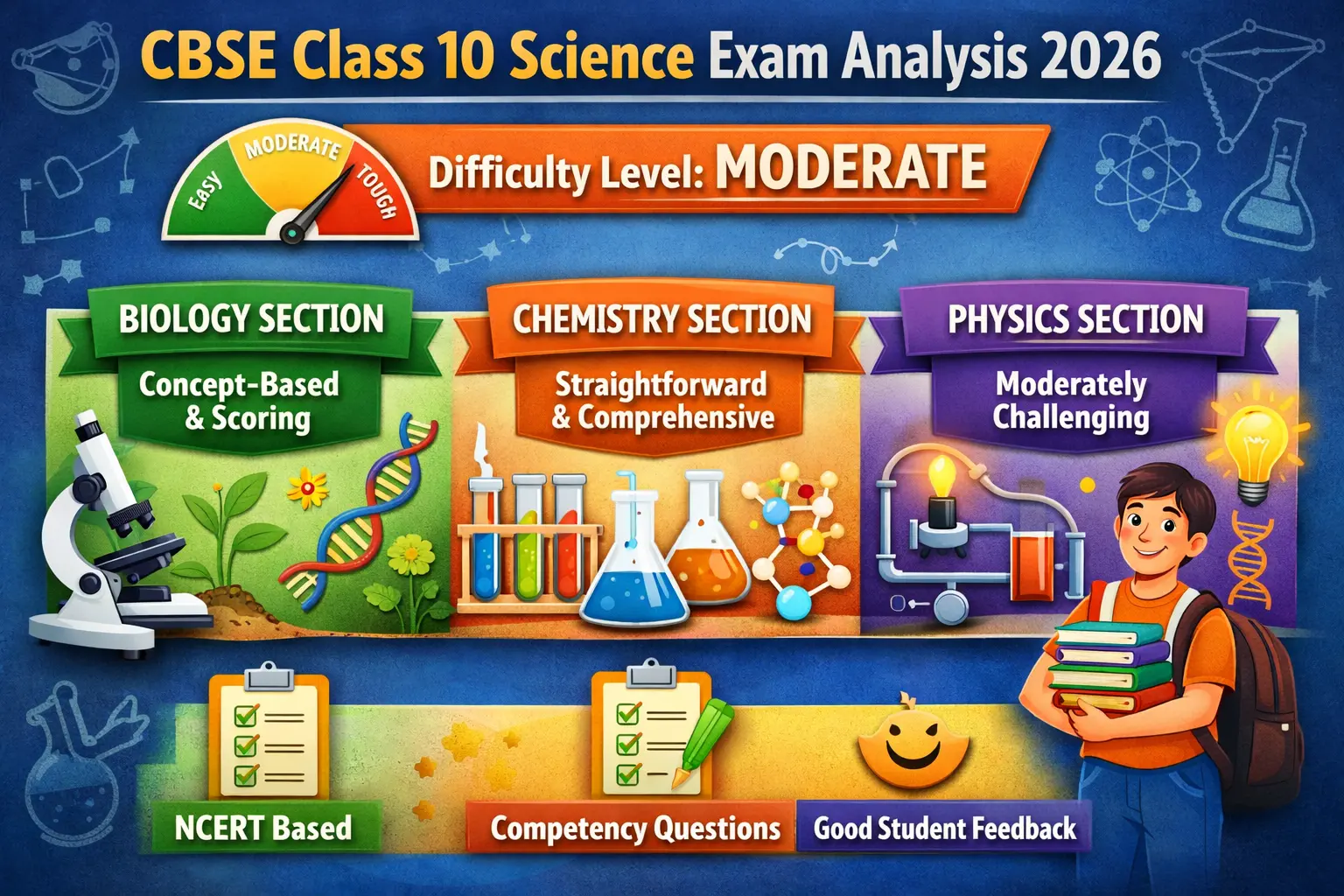
The CBSE Class 10 Science Examination 2026, conducted by the Central Board of Secondary Education on February 25, turned out to be a balanced and student-friendly paper. As per feedback from teachers and students across various schools, the overall difficulty level of the paper was moderate, with a healthy blend of direct, conceptual, and competency-based questions.
This year’s question paper maintained alignment with the CBSE sample papers and strictly followed the NCERT curriculum, making it a scoring opportunity for students who had prepared systematically.
Exam Pattern Overview
The Science examination was conducted for 80 marks, with a duration of three hours. The question paper consisted of 39–40 compulsory questions, divided into three main sections:
- Section A – Biology
- Section B – Chemistry
- Section C – Physics
Although all questions were mandatory, internal choices were provided in select questions to offer flexibility to students. The structure adhered to the revised CBSE pattern, emphasizing competency-based learning and application of concepts rather than rote memorization.
Overall Difficulty Level: Moderate and Balanced
Educators observed that the 2026 Science paper maintained a balanced structure. The majority of questions were based directly on the NCERT textbook and the official CBSE sample paper.
Teachers noted that:
- The MCQs were largely conceptual and straightforward.
- Competency-based questions tested understanding rather than memorization.
- Case-study questions required logical interpretation but were manageable.
- Numerical problems were fewer in number compared to previous years.
Students reportedly completed the paper comfortably within the allotted time. The expected average scores are likely to be higher this year due to the clarity and directness of the questions.
Section-Wise Analysis
Section A – Biology: Conceptual and Scoring
The Biology section was described as well-structured and thoughtfully framed. It covered all major topics from the syllabus and allowed students to demonstrate conceptual clarity.
Key Observations:
- A good mix of direct and analytical questions.
- Diagrams and concept-based questions were prominent.
- Most questions were scoring with proper preparation.
- The section tested critical thinking without being overly complex.
Students who thoroughly studied the NCERT textbook found this section approachable. Overall, Biology emerged as one of the more scoring parts of the paper.
Section B – Chemistry: Direct and NCERT-Based
The Chemistry section was widely appreciated for being straightforward and comprehensive.
Highlights:
- Nearly identical questions across different sets.
- Direct questions from NCERT concepts.
- Balanced coverage of all mark categories.
- Limited tricky or high-level application-based questions.
Students who focused on textbook exercises and in-text examples were able to attempt most questions confidently. The section was manageable and accessible to average and high-performing students alike.
Section C – Physics: Slightly Challenging but Fair
Physics was considered mildly challenging compared to Biology and Chemistry, but it remained within a moderate range.
Detailed Analysis:
- MCQs were simple and conceptual.
- Two- and three-mark questions were moderately difficult.
- Case-study questions required logical application.
- The five-mark electricity question required careful calculation in some sets.
While Sets 1 and 2 included calculation-intensive electricity problems, Set 3 reportedly featured a more direct formula-based application. Despite this, students who practiced numericals thoroughly were able to manage the section effectively.
Competency-Based and Case-Study Questions
The 2026 paper reflected CBSE’s continued emphasis on competency-based assessment. Rather than testing rote memorization, the questions focused on:
- Conceptual clarity
- Application of formulas
- Real-life scenario-based case studies
- Logical reasoning
This approach ensured that students who understood core principles performed better than those relying solely on memorization.
Comparison with Previous Year
Compared to the previous year’s paper:
- The 2026 paper was slightly more moderate.
- Fewer lengthy numerical problems were included.
- Questions were more direct and less ambiguous.
- The case-study questions were clearer and less complex.
Overall, this year’s Science paper can be classified as student-friendly and scoring.
Expected Result Trends
Based on teacher feedback:
- Students who thoroughly prepared from NCERT are expected to score well.
- Average scores are likely to be higher than last year.
- The paper offered ample opportunity for full marks in structured and direct questions.
- Time management was not a major issue this year.
If evaluation remains consistent with CBSE standards, the overall performance trend could reflect improved results in Science for 2026.
The CBSE Class 10 Science Exam 2026 successfully balanced conceptual depth with accessibility. It adhered strictly to the NCERT syllabus, incorporated competency-based learning, and maintained clarity across all three sections.
Summary of Difficulty Level:
- Biology: Easy to Moderate (Scoring)
- Chemistry: Moderate (Direct & NCERT-based)
- Physics: Moderate with slight difficulty in numericals
- Overall: Moderate and well-balanced
Students who prepared methodically and focused on understanding core concepts rather than memorizing answers found the paper manageable and rewarding.
The 2026 Science examination stands as an example of structured assessment aligned with modern educational objectives—testing knowledge, clarity, and analytical ability in equal measure.